
Your Local Mortgage Lender
Located in Yukon, Oklahoma

Meet Chris Barnes
I'm Chris Barnes, and for more than 25 years, my team and I have helped people navigate home financing with clear answers, honest advice, and a plan that fits their lives.
Whether you're buying, refinancing, or building, we take the time to understand what matters to you and explain your options so you feel confident moving forward. Our job goes beyond finding a loan: it's helping you choose a mortgage strategy that makes sense today and supports your goals down the road.
If you're a real estate agent or referral partner, you can count on me and the Barnes Mortgage Team to communicate, stay involved, and care for the people you send our way.
As a husband, dad, and "Poppy," I understand how much the right home means to a family. I'd love the opportunity to get to know you, answer your questions, and earn your trust.
Chris Barnes
Mortgage Loan Originator, NMLS #1179666 · Novus Home Mortgage · Yukon, Oklahoma
Personalized Mortgage Experience
Chris Barnes offers personalized service and loan options you'll love. We shop multiple lenders to find the best rate and product for you, getting you into your dream home faster.
With wholesale interest rates and cutting-edge technology, we make the mortgage process seamless. Trust the experts who focus solely on mortgages. Support your local community and experience elite client service.
Let us help you achieve your homeownership dreams!
The Home Loan Process
Mortgage Pre-Approval
Get pre-approved from one of our Loan Officers to see how much you can afford.
House Shopping
Work with a trusted Real Estate Agent to find a home you would like to move into.
Loan Application
Complete your home loan application to get the lending process started.
Don't take my word for it
Mortgage Programs
Experience the best mortgage experience located in Yukon, Oklahoma.
Home Loan Options
Our experienced mortgage advisors will walk you through the best mortgage loan program that will fit your specific scenario.
Conventional Home Loans.
FHA Home Loans.
USDA Home Loans.
VA Home Loans.
Non-QM / Portfolio Loans
DSCR Loans
Bank Statement Loans
Renovation Loans
Down Payment Assistance Programs
Refinance Loans
Frequently Asked Questions
How often can I refinance my mortgage?
There is no limit to the number of times you can refinance. However, you must qualify every time you apply and there will be costs associated with closing the loan each time.
Can I buy a home if I do not have money for a down payment?
Yes! There are a number of bond programs that offer low or no down payment financing options.
How do I know which mortgage is right for me?
The key to choosing the right mortgage is to understand the range of options and features available to you, as well as your budget, circumstances, and goals. Our licensed mortgage professionals are here to help you navigate that process. The more you know, the more comfortable and confident you will be choosing the best option for you and your family.
How long will the loan process take?
The Truth in Lending Act (TILA) does not permit a lender to close a loan until at least seven (7) business days have passed from the date your application was received. A typical home loan takes 30 days, as a number of third-party services such as appraisals, title work, and credit are required in conjunction with the mortgage process. Once you familiarize your Loan Officer with the details of your specific loan scenario, they will be able to provide you with a more specific timeline.
Will I qualify for a home loan?
The only way to find out is to speak with a qualified mortgage professional. Our Loan Officers have helped numerous clients who didn’t know if they could qualify to become home owners. We take the time to understand your financial situation and long-term financial goals, and then match you with the loan program that best fits your needs. Your approval for a loan may also largely depend on the price of the home you are financing. Getting pre-qualified prior to beginning your home search can give you an idea of what you may be able to afford.
Why do people refinance their mortgages?
Homeowners typically refinance to save money, either by obtaining a lower interest rate or by reducing the term of their loan. Refinancing is also a way to convert an adjustable loan to a fixed loan or to consolidate debts.
How much money will I have to pay upfront to buy a home?
This question does not have a simple, one-size-fits-all answer. The exact amount will depend on the price of the home you buy as well the type of mortgage financing you choose. Depending on your loan program, your down payment could be as much as 20% of the home’s price or as little as 3%, while some loans require no down payment at all.
Can I get a mortgage after bankruptcy?
You may still qualify for a home loan even if you have experienced a bankruptcy. The best way to find out if you qualify is to talk with a Loan Officer to discuss your options. Be sure to bring all paperwork regarding your bankruptcy so your Loan Officer can find the program that best fits your situation.
Should I lock my interest rate now, or wait until we are closer to our closing?
Interest rates fluctuate all day, every day. If an interest rate is good, it may be in your best interest to lock now. If you wait, you run the risk of an increase in rates later. If you are concerned that rates may go down after you lock, contact your Loan Officer to discuss your options. Some programs allow you to lock for an extended period and choose to lower your rate should a better one become available.
Most Recent Blog Updates
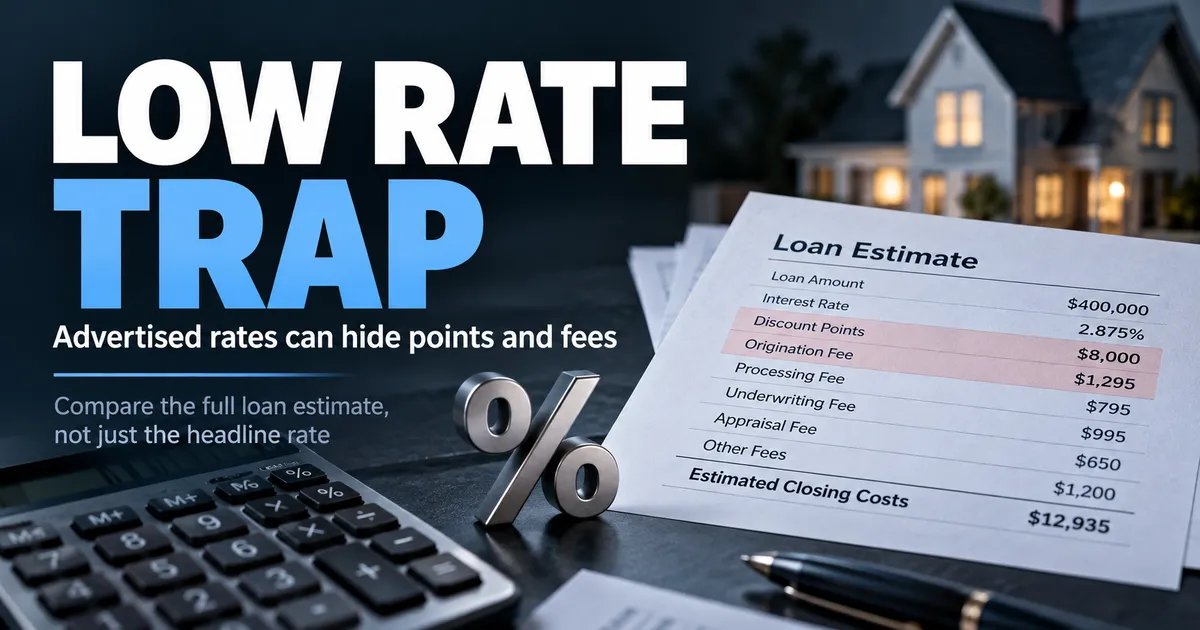
Shopping for the Lowest Mortgage Rate Online Is the Most Common Home Loan Mistake Buyers Make
The Number Everyone Chases and Why It Does Not Tell the Whole Story
Most people shopping for a home loan focus on one thing. Finding the lowest interest rate they can find online. It feels like the obvious move and it makes intuitive sense. A lower rate means a lower payment. How could chasing the lowest rate be a mistake?
Chris Barnes wants buyers to understand what those advertised numbers almost never tell you upfront because the gap between the rate that appears in an advertisement and the actual cost of that loan can be significant and is often deliberately obscured.
How Lenders Manufacture an Attractive Headline Rate
Lenders can advertise a lower rate by requiring borrowers to pay discount points at closing. One discount point equals one percent of the loan amount paid upfront in exchange for a reduced rate. On a three hundred thousand dollar loan one point is three thousand dollars. On a larger loan the cost scales accordingly.
A rate that appears a quarter percent lower than a competitor's offering may look better in a comparison but may require thousands of dollars in points to achieve that rate. Those points get buried in the fee structure rather than being prominently disclosed alongside the advertised number.
Junk fees add another layer to the same problem. Origination charges, processing fees, and administrative costs that vary significantly between lenders can inflate the actual cost of a loan well beyond what the interest rate comparison suggested. A loan that costs a quarter percent less in rate but several thousand dollars more in fees at closing is not necessarily the better deal depending on how long the borrower holds the loan.
What Smart Financing Actually Looks At
The total loan structure is what determines whether a financing option is genuinely favorable. The rate. The points paid to achieve it. The lender fees. The closing costs. The break-even point on any upfront cost relative to the monthly savings it produces. And how long the borrower expects to hold the loan before selling or refinancing.
A buyer who pays two thousand dollars in discount points to lower the rate by a quarter percent and then refinances or sells within two years never recovers that upfront cost regardless of how good the rate looked in the advertisement.
What to Do Instead
The Loan Estimate is the document that levels the playing field. Every lender is required to provide a standardized Loan Estimate when a borrower applies and comparing those estimates across lenders is how you see the true cost picture rather than the marketing version. The rate, the points, the fees, and the cash required at closing all appear in a format designed to make comparison straightforward.
Always compare the full Loan Estimate and the true fee breakdown before committing to any lender. The lowest advertised rate and the best actual deal are frequently not the same thing.
Send Chris Barnes a message for an honest side-by-side look at your real loan options so you can make a decision based on the complete picture rather than a headline number.
Sources
ConsumerFinancialProtectionBureau.gov
FannieMae.com
MortgageNewsDaily.com
Investopedia.com
BankRate.com

Mortgage Calculator
See your total mortgage payments using the tool below.
| Year | Interest | Principal | Balance |
|---|
Start your application with Chris Barnes at Novus Home Mortgage. It takes about 10 minutes and there is no obligation.
Apply NowCheck your inbox for the full breakdown. Chris will follow up if you have questions. Ready to move forward? Apply now.